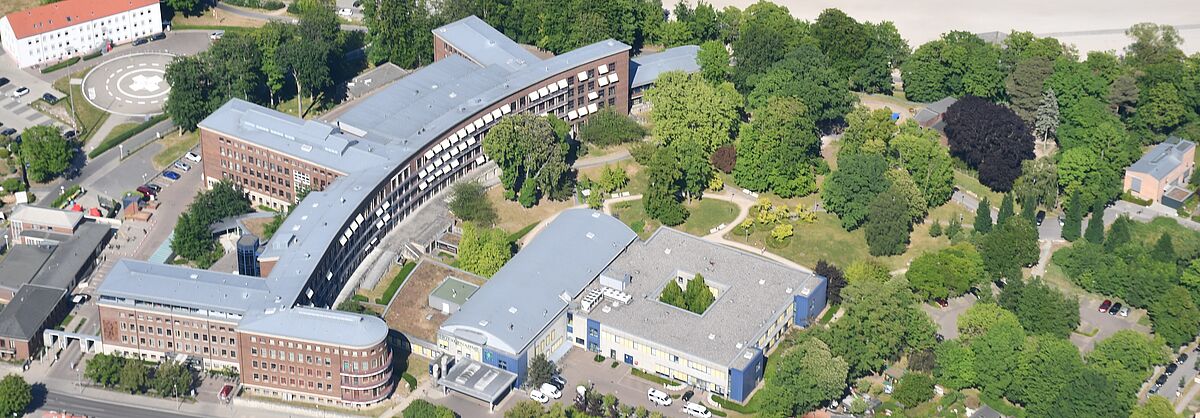
"Stralsund, Krankenhaus am Sund" (taken on 5 June 2023) by Nikolai Maria Jakobi, Source: Wikimedia Commons, License: CC BY-SA 4.0 [cropped]
As part of the research group AdaptInfra, SP 5 examines the adaptive processes of the healthcare landscape in rural and remote areas, using the German region Vorpommern as a case study. Healthcare is an essential public service as stipulated by the German Constitution, yet ensuring the availability of care is a particular challenge in rural and remote areas. Demographic and epidemiological changes (particularly the rise in chronic diseases among an aging population), as well as advances in medical technology, are increasing the demand for medical services, while open positions in hospitals and medical practices often remain vacant in rural and remote regions due to a shortage of healthcare professionals. In addition, political decisions (for example regarding local public transportation) and regulatory interventions such as the current hospital reform are producing profound structural changes. Consequently, conflicting values such as economic efficiency, quality and security of care, leave the rural population confronted with limited availability and accessibility of essential health services.
Using Vorpommern as a case study, SP 5 analyzes how the healthcare infrastructure is adapting to these structural, legal, and regulatory changes. To analyze the regional healthcare landscape, which can be viewed as a complex adaptive system, a hybrid simulation model is being developed that combines two complementary methods: an agent-based model (ABM) and a system dynamics model (SDM). The ABM simulates patients in the region with their individual characteristics, thereby providing insight into the specific demand for medical services and the population’s satisfaction. The SDM, on the other hand, models the level of service providers – i.e., hospitals and medical practices – and thus simulates the macrostructures and overall processes of the healthcare landscape. Consequently, the SDM provides crucial information about the locations of the services offered, their capacities, and the quality of care.
By integrating both models, each can respond to changes in the other, allowing for an analysis of the mutual interactions between individual demand and the systemic supply structure. In addition, it is possible to simulate how policy decisions (such as the introduction of nationwide telemedicine or adjustments to hospital financing) influence the infrastructure’s patterns of adaptation. This multi-method approach is thus intended to contribute to an understanding of the adaptive processes, enable forecasts, and, based on What-if scenarios, develop concrete recommendations for action aimed at achieving an optimal balance between security of supply and economic efficiency.

Figures taken from the following article: van den Berg N, Radicke F, Stentzel U, Hoffmann W, Flessa S. Economic efficiency versus accessibility: Planning of the hospital landscape in rural regions using a linear model on the example of paediatric and obstetric wards in the northeast of Germany. BMC Health Serv Res. 2019 Apr 24;19(1):245. doi: 10.1186/s12913-019-4016-2. PMID: 31018844; PMCID: PMC6480868.
Sub-project Information
Universität Greifswald - Business Administration and Health Care Management
Project Lead: Prof. Dr. Steffen Fleßa
Doctoral Candidate: Tim Döring
University Medicine Greifswald - Institute for Community Medicine
Project Lead: Prof. Dr. Neeltje van den Berg
Doctoral Candidate: Elena Reiser
Sub-project Partners